


Mahajan Embroidery
Mahajans of Kutch comprise the Oswal Banias residing in most areas of Kutch, particularly in the Wagad tract, Mandvi, and adjoining towns. The Oswal Bania caste is one of the sub-castes of the Shravak or Jain Banias. They are mainly merchants, shopkeepers, and traders.
Mahajans belong to the rich merchant class, who have for centuries, left a part of their families in Kutch and travelled far and wide, venturing into richer trading grounds. Down the ages, Mahajans have continued to conduct successful businesses not only in Mumbai (Bombay) and other parts of India but also in Persia, Arabia, Africa, China and Western countries. They maintained a permanent base in Kutch, indicating their love for their homeland and an inherent desire to be in constant contact with their roots.
The influence of various foreign cultures on the traditional lifestyle of the Mahajans of Kutch cannot be denied. Their mode of dressing has shown a transition from traditional attire to modern haute couture. Garments that are perceptibly foreign in material and cut are becoming increasingly popular. Saris worn in the Gujarati style are still preferred by the more conservative elders of the community, which may bear a subdued version of their renowned embroidery. The younger urbanised generation has less time available to dedicate to their traditional crafts. This unavoidable fallout of modernisation has led to the discontinuation of several lovely forms of Mahajan embroidery.
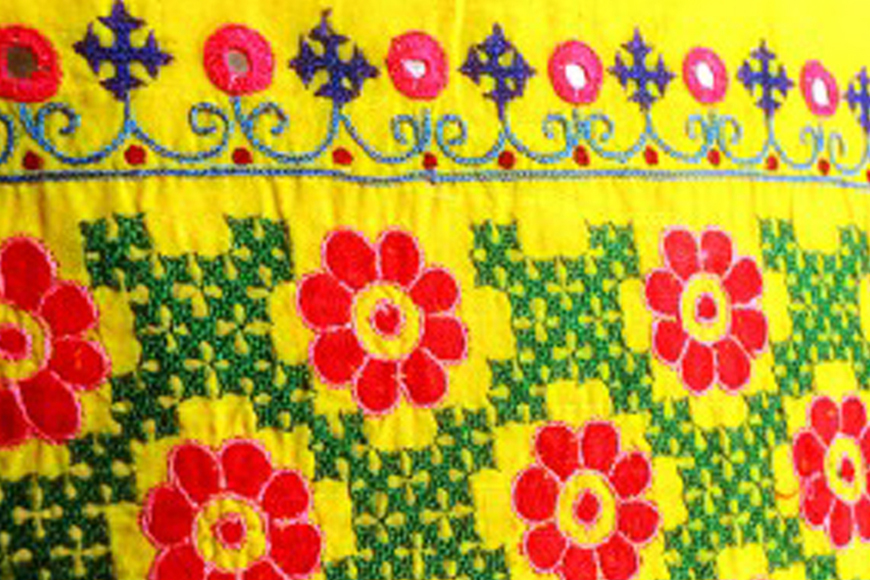
Cretan stitch, with origins in Crete in Greece is used a lot in this embroidery pointing to Greek interaction in the far past. Kutch was also a part of the empire of the Greek King Meander, who invaded India in 175 BC. During Greek rule in the neighbourhood of Kutch, sea routes carried the bulk of trade between the Mediterranean and the subcontinent, with Kutch playing a prominent role in the sea trade of this time due to her vast coastline. Many Greek merchants were active in Gujarat and Kutch, and there seems to have been a vigorous Greek community living along the West coast of India, which, by the 2nd century AD had become wholly Indianised.
Buy Now